

Outdoor weatherproof stickers – How to choose durable labels that last for years
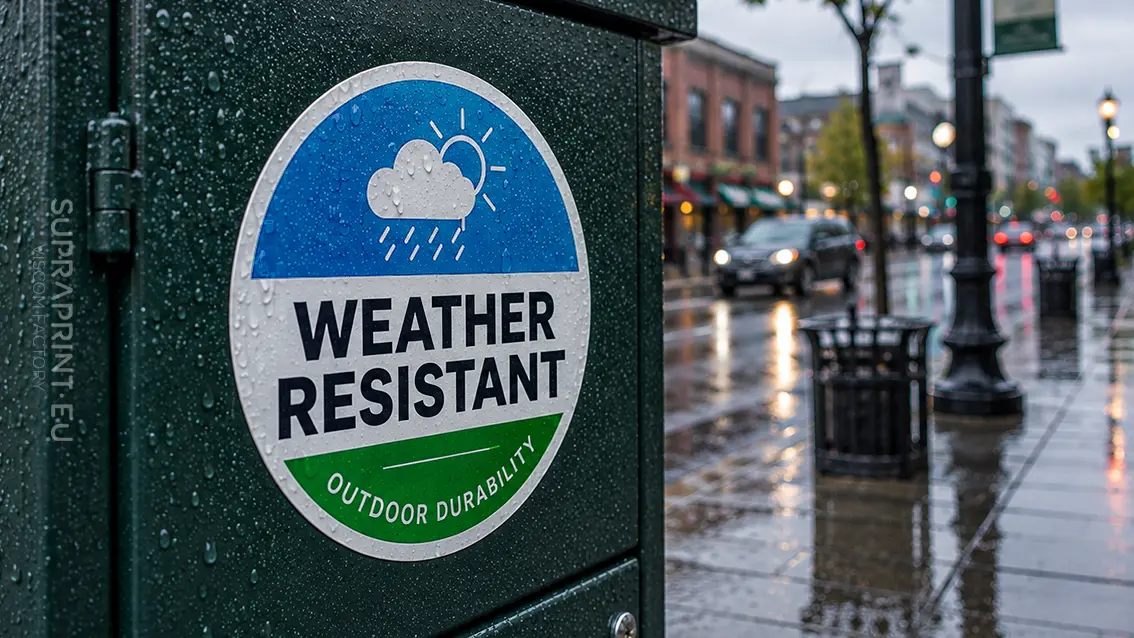
Durable outdoor stickers that perform well in all conditions.
Outdoor weatherproof stickers are suitable for applications where durability, aesthetics, and resistance to atmospheric conditions are important. Modern printing technologies and advanced self-adhesive materials ensure that professionally made stickers can retain their properties for many years, despite constant exposure to UV radiation, rain, snow, frost, or high temperatures.
Just a dozen or so years ago, outdoor stickers were primarily associated with simple advertising signage. Currently, their application is much broader. They are used in industry, logistics, the automotive sector, retail, the food service industry, construction, the public sector, and the production of product labels. We encounter them on company vehicles, shop windows, industrial machinery, electrical appliances, information boards, packaging, bicycles, boats, and elements of street furniture.
Rising user demands mean that water resistance alone is no longer sufficient. Resistance to abrasion, sunlight, chemicals, and temperature fluctuations is playing an increasingly important role. The appearance of the sticker is also significant. Even after several seasons of intensive use, it should retain its rich colors, crisp print, and strong adhesion to the surface.
However, choosing the right solution does not come down solely to the decision regarding the type of vinyl. The durability of signage is determined by a number of factors, such as material quality, the type of adhesive, printing technology, the use of a protective laminate, and the application method. Each of these factors influences the final result and the service life.
In this article, we present key information to help you select weather-resistant stickers tailored to your specific application and durability requirements.
What are weather-resistant stickers?
Weather-resistant stickers are self-adhesive printed materials designed for long-term outdoor use. They are manufactured from vinyl films or other specialized synthetic materials that retain their properties even after years of exposure to atmospheric conditions.
Their fundamental characteristic is resistance to moisture and UV radiation, yet professional products offer much more. High-quality printed self-adhesive vinyl withstand heavy precipitation, freezing temperatures, heat, wind, mechanical abrasion, and contact with various chemical agents. As a result, they are used in both simple advertising applications and demanding industrial environments.
In practice, this means that a well-made sticker can retain its properties for many years without fading, cracking, or peeling off the surface.
A major advantage of modern materials is also the ability to apply them to a wide variety of substrates. The stickers adhere perfectly to glass, aluminum, stainless steel, painted surfaces, plastics, composite panels, and many other materials used in advertising and industry.
Why is the durability of a sticker so important?
The biggest mistake when ordering stickers is letting price be the sole deciding factor. False economy often necessitates redoing the entire signage after just over a dozen months.
Solar radiation causes colors to fade gradually, moisture can weaken adhesive properties, and fluctuating temperatures affect material expansion. If the film is unsuitable for the installation site, it may crack, shrink, or peel at the edges.
For enterprises, this entails not only additional replacement costs but also damage to the brand image. Faded or damaged signage creates an impression of neglect and can negatively affect how customers perceive the company.
Durability is also important in the context of safety. This applies in particular to informational, warning, and identification labels used on machines, equipment, or industrial installations. A loss of legibility of such markings can lead to errors during equipment operation and increase the risk of accidents.
A well-chosen sticker is an investment for many years. Higher-quality materials translate into lower operating costs, less frequent replacement, and a better appearance throughout the service life.
What affects the durability of outdoor stickers?
There is no single parameter that determines a sticker’s durability. In reality, it is a combination of several elements that should complement each other.
The base material plays the most important role. It is the type of film used that determines resistance to deformation, UV radiation, and temperature fluctuations. Equally important is the adhesive responsible for a durable bond with the surface. A smooth glass surface requires a different solution than rough plastic or powder-coated steel.
Printing technology is also of great importance. Modern inks used in UVgel, latex, and solvent printing ensure high fade resistance and excellent color reproduction. When combined with a suitably chosen laminate, they form an effective barrier protecting the print against scratches, detergents, and sunlight.
The method of application cannot be overlooked either. Even the best film will not perform its function if applied to a dirty, damp, or greasy surface. Professional surface preparation often determines whether a sticker will look perfect for a few months or for many years.
Where are weather-resistant stickers most commonly used?
The range of applications for professional stickers is constantly expanding. They are used by large enterprises, small businesses, and individual customers alike.
In outdoor advertising, they are used for wrapping shop windows, billboards, light boxes, and signs. In the automotive sector, they serve as the basis for marking vehicle fleets, motorcycles, trailers, and specialized vehicles. They are also increasingly appearing on bicycles, scooters, and sports equipment.
In industry, they serve as identification labels, nameplates, safety signs, and technical information markers. In logistics, they are used to mark containers, warehouses, and transport equipment.
Their versatility makes it difficult to find an industry in which durable self-adhesive stickers do not play a significant role.
How do you recognize a professional outdoor sticker?
At first glance, most stickers look similar. The differences become apparent only after several months of use. Low-quality products begin to lose their color, peel at the corners, or crack due to temperature changes.
Professional weather-resistant stickers are distinguished primarily by their dimensional stability, high print quality, and carefully selected materials. Their surface is abrasion-resistant, and the adhesive ensures durable bonding even in demanding environmental conditions.
Types of materials used to produce weather-resistant stickers.
Selecting the right self-adhesive film is one of the most important stages in designing stickers intended for outdoor use. It is the type of film that determines resistance to UV radiation, temperature fluctuations, moisture, and mechanical damage. Even the highest-quality print will not guarantee long-term durability if produced on a material unsuited to the operating conditions.
Modern self-adhesive vinyls differ not only in thickness and flexibility but also in dimensional stability, surface type, and expected service life. Therefore, the choice of material should depend on the application site, the type of substrate, and the expected durability.
Monomeric vinyl – an economical solution for short-term applications.
Monomeric vinyl is one of the most frequently used materials in the advertising industry. Its greatest advantage is its favorable price-to-quality ratio, which is why it is used wherever the signage does not need to retain a pristine appearance for many years.
This material works best on flat surfaces, such as glass panes, PVC sheets, advertising boards, or shop windows. It is a perfectly adequate solution for short-term promotional campaigns or seasonal advertisements.
However, it should be noted that monomeric vinyl has limited dimensional stability. Prolonged exposure to high temperatures and intense sunlight can cause it to shrink gradually, eventually leading to the edges peeling or small gaps forming between the graphic elements.
Polymer vinyl – durability for demanding applications.
If the signage is to remain outdoors for many years, polymeric vinyl is a much better solution. Thanks to more advanced manufacturing technology, it is characterized by high dimensional stability and significantly greater resistance to atmospheric conditions.
Polymeric vinyls are ideally suited for use on vehicles, machinery, and industrial equipment, as well as in any application where the material is exposed to intense sunlight and frequent temperature fluctuations. Their structure limits the risk of shrinkage, ensuring the graphic retains its aesthetic appearance even after many seasons of use.
An additional advantage is greater flexibility. Weather-resistant stickers printed on polymeric vinyl allow for application onto surfaces with slight indentations or gentle curves, without the risk of material stress.
Cast vinyl – top quality for the most demanding projects.
Cast film is considered the most advanced material used in the production of professional stickers and advertising graphics. Its production process differs significantly from the technology used for monomeric and polymeric vinyls, resulting in a material that shows virtually no tendency to shrink.
That is precisely why cast vinyls are used for wrapping cars, buses, boats, and motorcycles, as well as any surfaces featuring deep recesses and complex shapes.
Their exceptional flexibility allows for a precise fit to almost any surface, and proper application yields a finish resembling a factory paint job.
Although it is the most expensive type of vinyl, for long-term projects the purchase cost is quickly recouped thanks to its long lifespan and excellent appearance.
Transparent vinyl – an elegant effect and a modern look.
Weather-resistant stickers printed on transparent vinyls are becoming increasingly popular. Thanks to the transparent substrate, the print appears as if applied directly to the surface of the glass, acrylic, or plastic.
Transparent outdoor stickers are a solution frequently used for shop windows, offices, restaurants, hotels, and visual communication.
Printing with white ink looks particularly impressive, as it enables high contrast to be achieved even on completely transparent material. At SUPRAPRINT, you can order stickers printed on standard transparent vinyl as well as on optically clear vinyl.
Types of adhesives used for outdoor stickers.
The material is just one of the factors determining the durability of the signage. The adhesive, which is responsible for the sticker’s adhesion to the surface, plays an equally important role. Modern technologies allow for the selection of the right type of adhesive for a specific application, enabling everything from durable industrial labeling to temporary advertising campaigns.
Standard permanent adhesive.
The most common solution is an acrylic adhesive with standard bonding strength. It works perfectly on smooth surfaces such as glass, aluminum, PVC panels, or lacquered sheet metal. After the appropriate amount of time, it achieves very high adhesion, ensuring a durable bond for the sticker.
High / Ultra Tack adhesive.
Not all surfaces are perfectly smooth. For low-surface-energy plastics, polyethylene sheets, containers, or powder-coated components, a High Tack or Ultra Tack adhesive performs significantly better. Its enhanced bonding strength allows it to adhere effectively even to challenging materials where standard adhesives might lose their grip over time.
Removable adhesive.
Some projects are temporary in nature. This applies to, among other things, seasonal promotions, advertising campaigns, and event signage. In such cases, removable adhesives are used, allowing the sticker to be removed without leaving significant adhesive residue on the surface. This solution is particularly valued by shops, shopping malls, and event organizers.
Adhesive with channel technology.
For large advertising graphics, films featuring a micro-air-channel system offer a significant advantage. This technology allows for the easy removal of air bubbles during application and significantly reduces installation time. That is precisely why air-release vinyls have become the standard for wrapping vehicles and large advertising surfaces.
Easy Dot adhesive – easy, bubble-free application.
Easy Dot adhesive facilitates the quick and precise application of stickers without the formation of air bubbles. Thanks to a special micro-dot structure, air escapes freely from beneath the film, allowing for easy positioning and installation, even without prior experience. This solution works best on smooth surfaces—such as glass panes, shop windows, or furniture panels—as well as for short-term advertising campaigns and decorations where the ability to easily remove the sticker is important.
Why is laminate so important?
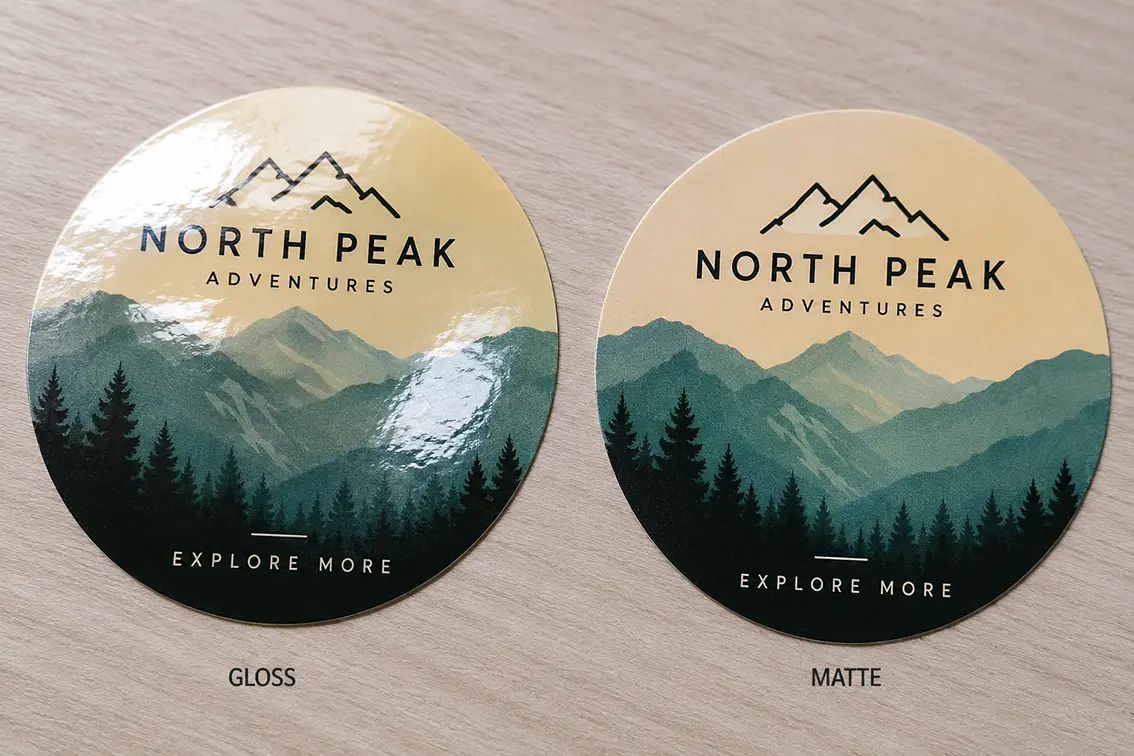
Many clients focus exclusively on the type of vinyl, overlooking one of the most important factors affecting the sticker’s durability. This element is a protective laminate.
The laminate forms a transparent layer that protects the print against mechanical damage, UV radiation, moisture, and the effects of chemicals. Thanks to it, the surface becomes significantly more resistant to scratches and abrasion.
In practice, this means not only a longer lifespan for the graphics but also better retention of color intensity.
SUPRAPRINT offers a glossy laminate that enhances color saturation, a matte laminate that eliminates light reflections, and a textured R10 anti-slip laminate.
Laminates with enhanced chemical resistance and anti-graffiti laminates—which allow for the removal of paint and marker ink without damaging the print—are also increasingly being used in industrial applications.
Printing technologies used in the production of outdoor stickers.
The quality of weather-resistant stickers is determined not only by the material but also by the printing technology used. The SUPRAPRINT printing house employs several solutions, each with its own advantages.
UVgel printing ensures very high mechanical resistance and excellent color reproduction. Ultraviolet-cured ink forms a hard coating resistant to abrasion and atmospheric conditions. This technology is particularly valued in the production of industrial labels and signage requiring maximum durability.
Latex printing uses water-based inks, making it an environmentally friendly solution that also offers excellent weather resistance. High-quality color reproduction makes this technology suitable for use in both advertising and label production.
Eco-solvent printing has remained one of the most popular solutions in the advertising industry for many years. It ensures a durable print, good color saturation, and a favorable ratio of quality to production cost. When the appropriate laminate is applied, it performs excellently in most outdoor applications.
The choice of the appropriate technology should always take into account the sticker’s application site, expected durability, and the type of material being printed on. Only a combination of high-quality film, the right adhesive, durable ink, and a well-chosen laminate ensures that outdoor-resistant stickers retain their appearance for many years.
Resistance of stickers to weather conditions and external factors.
The durability of a sticker designed for outdoor use is no accident. This is the result of combining carefully selected materials, high-quality printing technology, and proper application. Even the best self-adhesive film will not perform its function if applied under improper conditions or onto an inadequately prepared surface.
Professional outdoor stickers are designed for long-term use. They must remain legible and aesthetically pleasing regardless of the season, the intensity of sunlight, or humidity levels. In many cases, weather-resistant stickers remain adhered to a surface for five, seven, or even ten years; therefore, resistance to environmental factors is one of the most important parameters determining their quality.
UV radiation – the greatest enemy of a durable print.
One of the factors that most rapidly causes the appearance of stickers to deteriorate is ultraviolet radiation. Prolonged exposure to the sun leads to the gradual breakdown of the pigments responsible for color intensity. As a result, the graphic begins to fade, and the contrast between the individual design elements becomes increasingly less distinct.
This process occurs particularly rapidly with low-quality materials and cheap inks that were not designed for outdoor use. After several months of intense sunlight, the differences can be very noticeable, especially in red, yellow, and orange colors.
Modern printing technologies utilize inks with enhanced UV resistance. When combined with a suitably selected protective laminate, they allow the depth of color to be maintained for many seasons. This is particularly important for corporate visual identity, where color consistency influences brand recognition.
Resistance to water and high humidity.
Stickers intended for outdoor use must retain their properties during heavy rainfall, accumulated snow, and prolonged exposure to moisture. This applies to both the vinyl itself and the adhesive layer.
Professional vinyl films do not absorb water, so they do not swell or lose their mechanical properties. Equally important is a suitable acrylic adhesive that retains high adhesion after fully curing, even in conditions of high humidity.
Water resistance is of particular importance for the labeling of boats, recreational equipment, garden machinery, containers, and vehicles used year-round.
Freezing cold, heat, and rapid temperature fluctuations.
In the European climate, weather-resistant stickers must perform across a very wide temperature range. In summer, the surface of a dark car left in the sun can reach temperatures exceeding 70°C, whereas in winter it can drop well below freezing.
Low-quality materials are often not prepared for such large fluctuations. Thermal expansion can give rise to stresses leading to film wrinkling, corner peeling, or cracking of the print.
Premium-grade vinyls are designed with these phenomena in mind. They remain flexible in both freezing and high temperatures, ensuring they retain their dimensional stability and aesthetic appeal for many years.
Resistance to abrasion and mechanical damage.
In many applications, the label is regularly exposed to contact with hands, tools, brushes, pressure washers, or parts of the products being transported. Without proper protection, the print could very quickly become damaged.
Therefore, professional applications employ protective laminates that enhance the surface’s resistance to scratching and abrasion. This is particularly important for information boards, industrial labels, and signage for machinery and vehicles.
Additional protection is provided by modern laminates with enhanced chemical resistance, which safeguard the surface against detergents used during cleaning and maintenance.
Chemical resistance.
Not all weather-resistant stickers operate in a friendly environment. In manufacturing plants, laboratories, workshops, or warehouses, there is frequent contact with oils, lubricants, industrial alcohol, or cleaning agents.
In such applications, it is necessary to use materials and laminates that are resistant to chemical substances. A suitably selected solution ensures the legibility of the marking is maintained, even when the surface is regularly cleaned or disinfected.
How do you properly apply outdoor stickers?
Even the highest-quality material will not guarantee the expected result if it is installed improperly. Professional application begins long before the sticker is actually applied.
Proper surface preparation is the foundation. It should be clean, dry, and thoroughly degreased. Even a thin layer of dust, wax residue, or silicone can significantly reduce the adhesive’s effectiveness.
In the case of newly painted components, it is advisable to ensure that the paint curing process has been completed. Applying it too early can lead to adhesion problems and make it difficult to remove the sticker later.
The installation temperature is also important. Most manufacturers recommend application at temperatures between approximately 10 and 25°C. A temperature that is too low reduces the adhesive’s activity, whereas one that is too high can make it difficult to position the graphic correctly.
After applying the sticker, it is advisable to keep it away from water for a period ranging from over a dozen to several dozen hours. During this time, the adhesive reaches its final bond strength.
Most common mistakes when choosing and using stickers.
One of the most common mistakes is choosing a material based solely on price. Inexpensive films are suitable for short-term advertising campaigns but should not be used where long-term durability is required.
An equally common problem is forgoing the protective laminate. Cutting corners at this stage can shorten the sticker’s lifespan by as much as several years, especially if the graphic is exposed to intense sunlight or frequent mechanical contact.
Some users also skip the substrate preparation stage. Applying the film to a dirty or greasy surface leads to the edges gradually peeling off and the formation of air bubbles.
It is also worth remembering that not every film is suitable for application on surfaces with complex shapes. Attempting to use monomeric vinyl on deep recesses almost invariably results in it peeling off or becoming deformed.
Where do weather-resistant stickers work best?
The range of applications for professional stickers is constantly expanding. They are used wherever signage must remain legible for a long time, despite adverse weather conditions.
In outdoor advertising, they constitute a fundamental element of visual identity. They can be found on shop windows, light boxes, billboards, pylons, and signs. Their durability helps reduce costs associated with the frequent replacement of promotional materials.
In the automotive industry, they are used for full vehicle wraps as well as for creating advertising graphics, fleet numbers, technical markings, and decorative elements. Thanks to their high resistance to UV radiation and pressure washing, they retain their aesthetic appearance for many years.
The industrial sector uses stickers for marking machinery, equipment, and process installations, as well as for warning signs. In such applications, resistance to abrasion, chemicals, and temperature fluctuations is of key importance.
Professional stickers also find application in the public sector. Signage for parks, bus stops, sports facilities, urban infrastructure, and tourist trails must remain legible for many years, regardless of weather conditions. In such projects, the durability of materials has a direct impact on user safety and infrastructure maintenance costs.
Properly designed and manufactured weather-resistant stickers combine high aesthetic appeal with functionality. Their versatility makes them one of the most effective methods for the permanent marking of products, equipment, and public spaces, while the right choice of materials ensures a result that will serve its purpose for many years to come.