

Digitally cut DTF prints for individual pieces
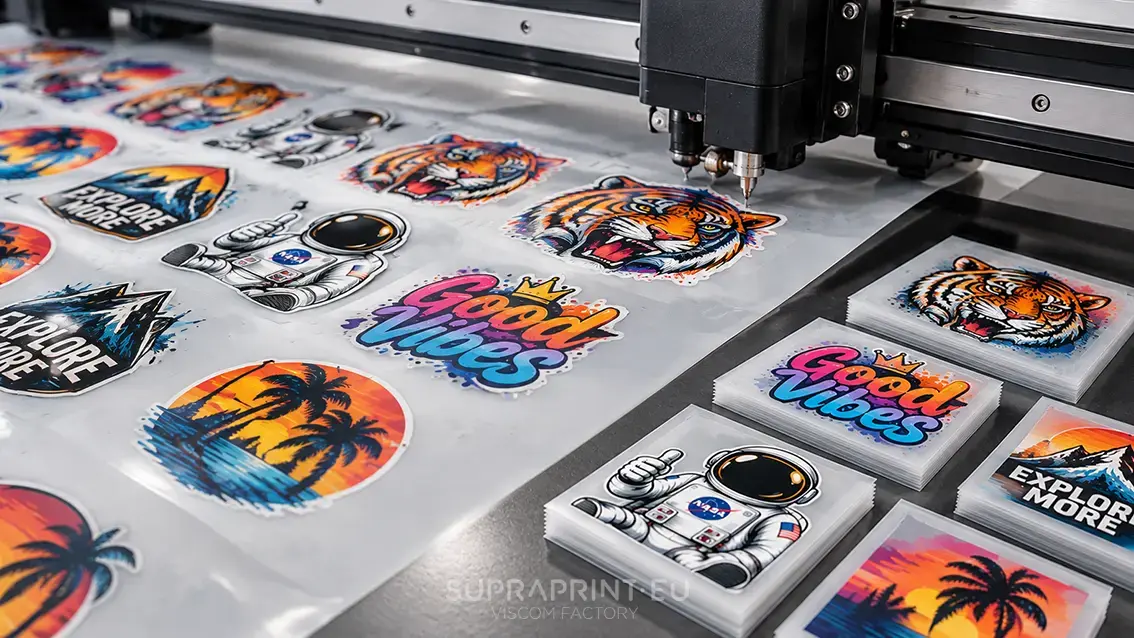
Your digitally cut Gang Sheet transfer.
DTF prints cut into individual pieces are currently one of the most sought-after methods for preparing prints for garment decoration. However, it is worth noting an important point that often goes unnoticed when comparing offers. Ordering DTF transfers by the meter does not mean you receive ready-made, individual prints.
In a typical solution, you simply receive a printed strip of DTF film of a specific length. It contains pre-prepared graphics that need to be separated manually after the order is received. Most often, this simply means cutting by hand with scissors.
At SUPRAPRINT, we solved this problem differently. In addition to printing itself, we offer automatic imposition of multiple graphics onto DTF film and digital cutting of the finished transfers into individual pieces. This way, you receive not only printed transfers but also precisely prepared elements ready for application.
DTF by the meter – prints that still need to be cut?
In practice, a standard DTF transfer sold by the meter is a print produced on a continuous strip of transfer film. A single section may contain multiple different graphics, yet once printed, they still form one larger sheet or strip of film.
Therefore, the individual prints must be separated before application begins.
With a few large graphics, this isn’t particularly bothersome. Scissors or another tool for manually cutting the film are sufficient. The problem arises when a single section contains a dozen, several dozen, or even more different prints. Each of them must be located, cut to the appropriate length, and prepared for heat-sealing.
This is extra work you don’t have to do when using digital cutting for DTF transfers.
Automatic imposition of multiple DTF graphics onto a single sheet of film.
Our solution begins as early as the file preparation stage.
You can order multiple different graphics, and the system automatically arranges them on the DTF film, making the most efficient use of the available space. You do not have to prepare a single large sheet with the prints arranged correctly yourself.
You can simply provide your graphics, specify their sizes and quantities, and the system will automatically prepare the imposition.
This is of particular importance for orders consisting of many different projects. Instead of preparing each print separately, you can combine them into a single optimized layout.
Is each transfer cut out separately?
Exactly. However, that is where the difference between standard DTF printing by the meter and our solution ends. After printing, the film is fed into a cutting plotter, which automatically cuts out the individual transfers according to the prepared cut lines.
As a result, you do not receive a single long strip of printed film that you have to cut yourself.
You receive individual, digitally cut DTF transfers.
Each element is precisely separated from the rest of the film, making the transfers ready for further application.
Precision that is hard to expect from manual cutting.
Ręczne cięcie nożyczkami jest wystarczające, jeżeli najważniejsze jest tylko rozdzielenie większych fragmentów folii. Nie zapewnia jednak takiej samej powtarzalności i precyzji jak cięcie cyfrowe.
Przy ręcznym cięciu każdy transfer może zostać przycięty nieco inaczej. Raz odległość od grafiki będzie większa, innym razem mniejsza. Przy dużej liczbie nadruków takie różnice są naturalnym efektem ręcznej pracy.
Digital cutting of DTF transfers eliminates this problem.
Each transfer is cut along a precisely defined outline. Thanks to this, individual units are prepared evenly and consistently.
This is significant not only for aesthetic reasons. A precisely separated transfer is also much easier to position correctly on the garment.
Easier and significantly more precise heat application of transfers.
It is precisely here that digital cutting offers one of its greatest advantages.
Proper positioning is crucial when applying a DTF transfer. The print should be positioned exactly where planned on the printed T-shirt, personalized hoodie, or other printed textile product.
If you are working with a single, precision-cut transfer, you can easily position it relative to the garment’s edges, seams, or other elements. You do not have to handle a large section of film containing several adjacent prints.
A single transfer is simply more convenient to apply.
This is of particular importance in clothing production, where repeatability is required. If you are preparing dozens of T-shirts with the same print, the ability to quickly and accurately position each transfer directly translates into greater convenience and a faster workflow.
A significant difference in precision when heat-applying a wide variety of prints.
Imagine an order comprising 50 different graphics.
With standard DTF printing by the meter, you receive a strip of film containing all the prepared prints. Next, you have to locate and cut them open by hand.
With our solution, all graphics are first automatically arranged on the film, and then each one is digitally cut out as an individual piece.
This means significantly less work on your part.
You do not need to prepare an imposition. You do not need to manually cut the entire roll. You don’t have to wonder how best to utilize the film surface. You receive ready-made, individual transfers.
DTF Gang Sheet and digital cutting – combining two stages.
This solution works particularly well for DTF Gang Sheet technology.
A gang sheet allows you to combine multiple different graphics onto a single area of film. Automatic imposition enables their optimal arrangement, allowing for better utilization of the material surface.
Next, digital cutting separates the prepared graphics into individual transfers.
The entire process therefore looks as follows:
multiple graphics → automatic imposition → DTF printing → digital cutting → individual transfers ready for application
Not just printing, but ready-to-use transfers.
With standard DTF printing by the meter, part of the work falls to the customer. The printing house prints onto the film, but the client must subsequently prepare the individual transfers themselves.
Digital cutting shifts this stage to the print shop.
This allows you to focus on what matters most—applying prints to garments—instead of spending time manually preparing each transfer.
This is particularly important for clothing manufacturers, printing shops, sewing workshops, online stores, and anyone who regularly applies large numbers of prints.
When is it worth choosing digitally cut DTF transfers?
If you need a few large prints that you can quickly cut apart by hand, classic DTF by the meter might be sufficient.
However, if you are ordering a wide variety of graphics, small prints, or larger batches—or if you need a fast and precise way to prepare transfers for application—digital cutting offers a clear advantage.
Especially when the time spent manually cutting apart dozens or hundreds of prints starts to matter.
More than just DTF transfers by the meter.
DTF printing by the meter enables the efficient production of a large number of prints, but the roll print itself does not solve the problem of subsequently separating them.
Our solution combines the automatic imposition of multiple graphics with the digital cutting of each transfer into individual pieces.
Thanks to this, you receive transfers that are evenly and precisely cut, easy to position, and convenient to apply.
It is precisely this difference that makes digitally cut DTF transfers a particularly attractive solution for those who do not want mere “continuous prints” but require ready-made, individual transfers prepared for heat application onto garments.